
Morgan County Projected Release Dates
A projected date is a calculation based on the sentence, legal eligibility, credits, restrictions, and information known when the record was produced. An actual release is the recorded event when custody under that authority ends. Missouri uses more precise terms, including Sentence Minimum Release Date, Sentence Maximum Release Date, conditional release, and projected time credit release date. Those labels are not interchangeable.
Morgan County’s public jail roster does not publish a projected release date. It shows a completed release timestamp only after a booking has been marked released. Before that point, a pretrial detainee’s exit can turn on bond, a judge’s order, another hold, or administrative processing. A local sentence can also involve jail credit and overlapping matters. No Morgan County-specific good-time schedule or weekend-release policy was found, so a date should not be calculated from the booking date, charge, or bond amount.
Scheduled versus actual: A minimum, projected, or presumptive date is not confirmation that the person left custody. Use the releasing authority’s event record.
Find Morgan County Projected Release Records
Start with the custody authority. The Morgan County Adult Detention Center, MODOC, BOP, and ICE maintain separate records. A county roster exit can be a transfer to one of those systems. For a state sentence, use the MODOC Offender Web Search for active status, then turn to the Sunshine data or agency contact when the public profile lacks the date or the person has fully discharged.
- Confirm whether the person is in Morgan County jail, a MODOC institution, field supervision, federal custody, or immigration custody.
- For a county detainee, ask detention staff whether a court sentence exists and whether another hold affects release.
- For an active state offender, search by MODOC number when possible and compare identity details carefully.
- Record the exact date label, its source, and the date on which the source was checked.
- Compare minimum and maximum fields, sentence-completed status, location, and institution-versus-field function.
- Near the date, confirm the individual calculation with the institutional caseworker or assigned field officer.
The official offender-search entry point shows the active-record scope and requires users to proceed through its verification step.
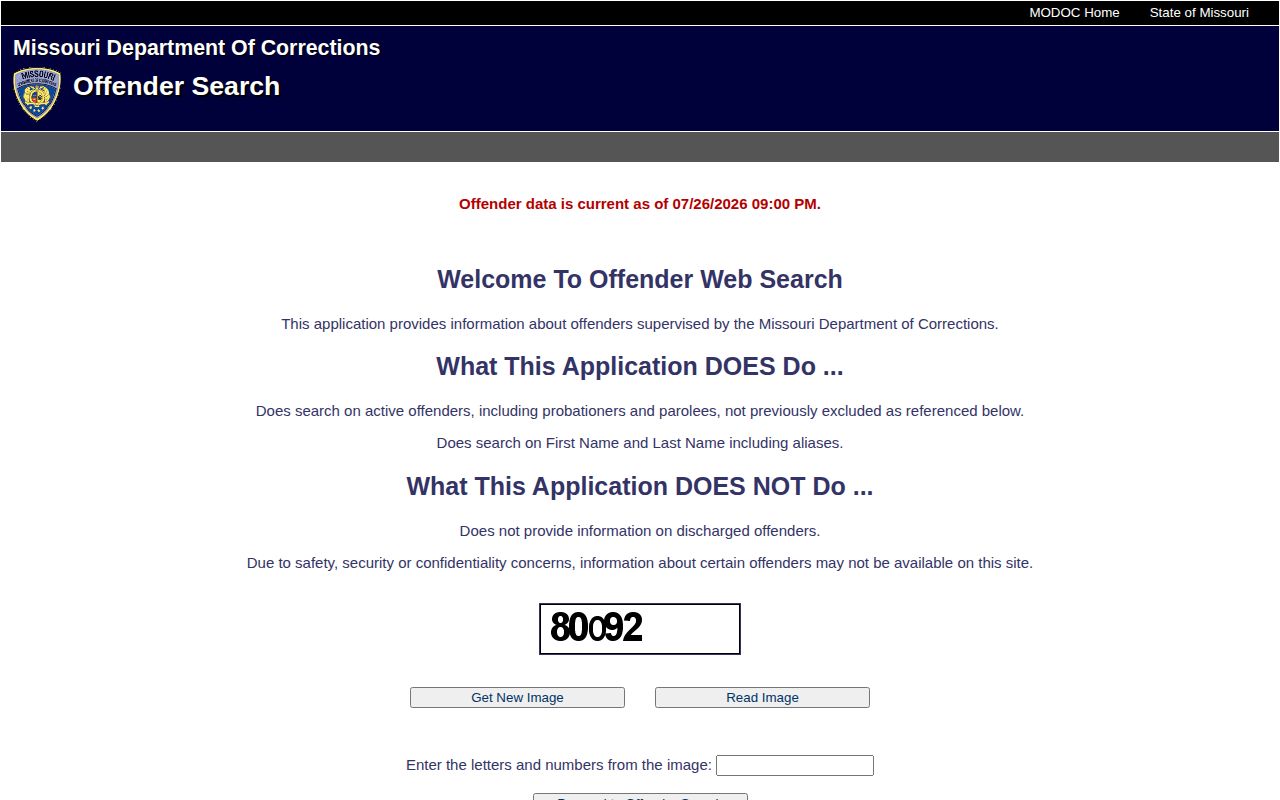
The search is useful for active custody and supervision, but its own scope excludes discharged offenders and does not replace a final release record.
Morgan County MODOC Release Fields
MODOC’s Sunshine Law offender data is a compressed nightly product described as covering people who have been or are under supervision, with data reaching as far back as 1974. It is not a simple recent-release list. Multiple charge-level rows may represent one person, and the agency warns that the data can be incomplete, inaccurate, or not current.
The verified layout includes the permanent DOC identifier, name, date of birth, assigned place, institution or field function, court cause number, sentencing county, offense, sentence date and length, concurrent or consecutive indicator, sentence maximum release date, sentence minimum release date, sentence-completed flag, and probation data. These fields allow a careful Morgan County release-date lookup when the active interface does not expose enough detail.
| MODOC field | What it can establish |
|---|---|
| Sentence Minimum Release Date | The recorded conditional-release date for that sentence, not a guaranteed exit |
| Sentence Maximum Release Date | The recorded full expiration or end date for the sentence |
| Sentence-completed flag | Whether that sentence is recorded complete, not whether another authority remained |
| Assigned place and function | Whether the record points to an institution or field/community role |
| Concurrent/consecutive indicator | How sentence order may affect the combined calculation |
Special values are codes, not dates. In specified fields, 99999999 represents life, 88888888 an indeterminate or interstate sentence, and 66666666 a field-supervision court assessment or investigation. Preserve those meanings instead of formatting them as calendar entries.
Morgan County Conditional Release Formula
For eligible Missouri felony terms of years, section 558.011 divides the sentence into a prison term and a conditional-release term. The statute excludes dangerous felonies and fourth-or-subsequent MODOC remands as it specifies. Conditional release means leaving the prison term under Board conditions and Probation and Parole supervision, not the final end of the sentence.
| Sentence term | Conditional-release portion |
|---|---|
| Nine years or less | One-third of the term |
| More than nine through fifteen years | Three years |
| More than fifteen years | Five years |
The prison term is the remainder. An otherwise eligible nine-year sentence therefore has a three-year conditional-release component and a six-year prison component before other lawful calculations and limits. An eligible twelve-year term has a three-year conditional-release component and a nine-year prison component. These are teaching examples, not predictions for a person.
Jail credit, consecutive sentences, exclusions, Board action, institutional credits, detainers, and new judgments can change the usable result. The Board may extend a conditional-release date up to the whole sentence after a violation and the required process. Always check the conviction statute, sentence date, and governing version of law.
Morgan County 85-Percent Release Rule
Missouri does not impose an 85-percent rule on every state prisoner. Section 558.019(3) applies the minimum prison term to a person found guilty of a dangerous felony as defined by section 556.061 and committed to MODOC. The person must serve 85 percent of the sentence, or reach age seventy after serving at least 40 percent, whichever occurs first.
“Minimum prison term” concerns eligibility for parole, conditional release, or another early release. The statute also has separate repeat-commitment and calculation rules. It treats life as thirty years and, for specified arithmetic, an aggregate over seventy-five years as seventy-five. Those provisions must be tied to the actual conviction and status. A booking charge on the Morgan County roster cannot establish that the rule applies because charges may change and are not judgments.
Note: Never apply the 85-percent figure without confirming the qualifying conviction, commitment, and governing statute.
Morgan County Institutional Time Credit
Missouri correctional regulations define institutional time credit as days subtracted from incarceration and use the phrase “projected time credit release date” for an eligible calculation. Release on that date is treated as administrative-parole consideration, not a promise. Eligibility, behavior, program involvement, exclusions, and the current rule control the result.
Institutional time credit is different from earned compliance credit. Institutional credit can affect an anticipated prison-release calculation. Earned compliance credit under section 217.703 applies after a person is on qualifying probation, parole, or conditional release and can move the person toward early final discharge from supervision. Mixing these two kinds of credit produces a false Morgan County projected release date.
The current 14 CSR 10-5 rule should be read before attempting any credit calculation. Individual eligibility questions belong with the institutional caseworker or assigned field officer because the public record may not contain every needed fact.
Why Morgan County Release Dates Change
A projected date can move even when the sentence length does not. Corrections staff may receive a corrected judgment, apply jail credit, determine that terms run consecutively, or update eligibility. The Parole Board may act on parole or extend conditional release after a violation. A detainer can leave the date intact while changing the person’s destination to another authority.
| Factor | Possible effect |
|---|---|
| Corrected judgment or jail credit | Changes the time credited or the sentence calculation |
| Concurrent versus consecutive terms | Changes how multiple sentences combine |
| Credit award, loss, or eligibility change | Moves a credit-based projected date |
| Program or conduct requirement | Affects eligibility under the applicable rule |
| Board decision or violation | May advance parole or extend conditional release |
| Detainer or another case | May transfer custody rather than produce community release |
| Data correction | Updates a public field without a new custody event |
MODOC cautions that public data may not be current or complete. Capture the field’s exact name and the date checked. A minimum date that has passed calls for a current location or field-supervision check, a completed-status record, or direct confirmation. It does not automatically become proof of release.
Morgan County Jail Release Timing
The county jail and state prison calculations should not be blended. Morgan County’s public release view displays exact booking and completed release timestamps for about forty-eight hours. It does not display a scheduled county release date. A court order may set the legal basis for release, yet the jail record is still the better source for the physical exit time.
Call the Morgan County Adult Detention Center at 573-378-5481 for current release-timing questions. Match the booking number and ask whether another hold, transfer, or processing step affects the result. For an older event, a focused Sunshine request can seek admission and release times, release type or disposition code, and transfer or release destination when releasable. Case.net can supply the judgment, sentence, bond order, and later docket entries.
A county “release” can still be a transfer to MODOC, another jail, BOP-related custody, or ICE. The timestamp proves that Morgan County custody under that booking ended. It does not by itself prove that the person entered the community.
Confirm Morgan County Actual Release
Near a state release date, contact the institutional caseworker or assigned officer. After release to parole or conditional release, an active MODOC result may shift from institution to field supervision. Final discharge is later and may require the Board’s order or certificate. A person can remain searchable as an active offender while physically outside prison.
For a local jail event, compare the Sheriff’s released timestamp and ask the jail whether the destination was the community or another authority. A person-specific alert may help with a pending custody change; current Missouri notification steps are detailed on the VINE Inmate Check page. Alerts can lag and are not certified records.
For a historical state endpoint, request commitment and release dates, release mechanism, minimum and maximum calculations, sentence-completion data, and any final discharge order. Give the full name, MODOC number, date of birth, and relevant custody period. Precise requests are easier to match than a request for every record associated with a person.
Keep prison release and final discharge separate in the response. A field-supervision status supports physical release from a MODOC institution while state authority continues. A sentence-completed flag concerns the listed sentence, and another sentence or detainer may remain. The strongest endpoint is a dated agency record tied to the exact person, sentence, and authority. For an old Morgan County case, pair that state record with the public judgment when available. This preserves both the custody event and its legal context.